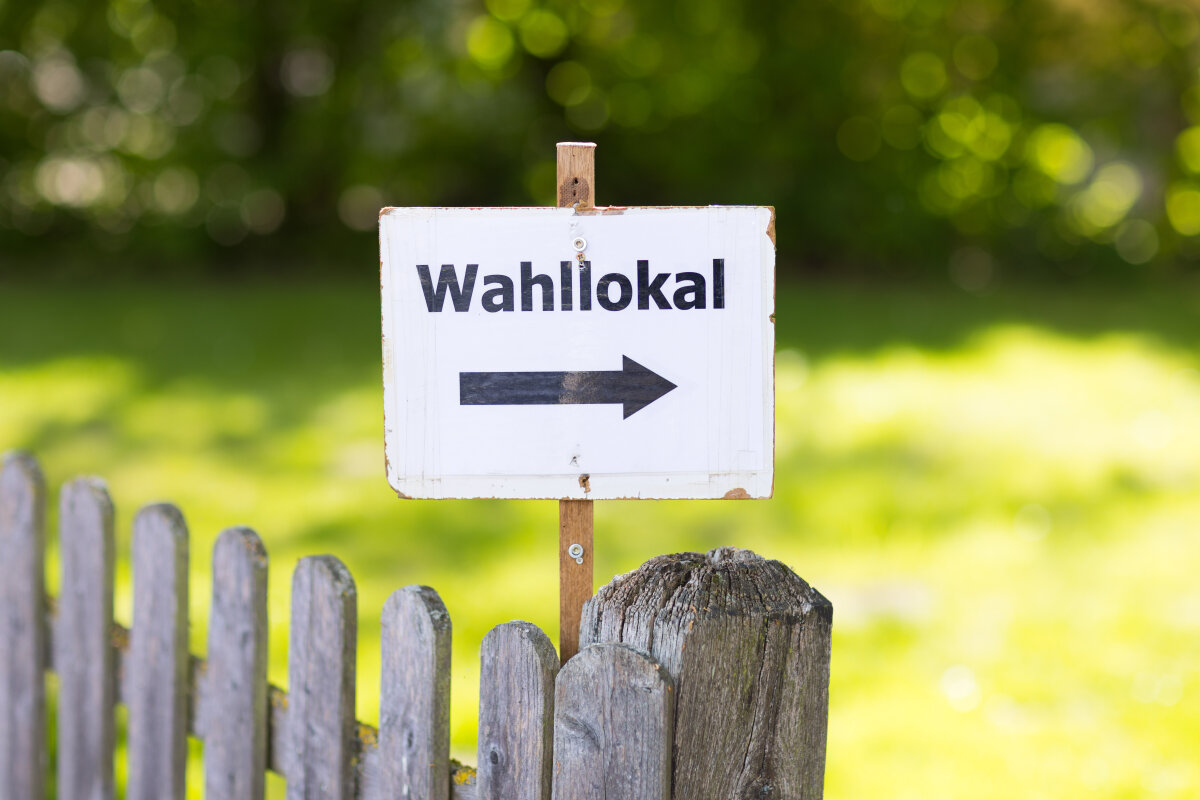
 copyright: Foto 2022 von www.ChristianSchwier.de
Local elections 2025
This page was translated from German using artificial intelligence. The translation may contain errors or inaccuracies. In case of doubt, the German original version prevails.
#####
Following the announcement of the Ministry of the Interior of the State of North Rhine-Westphalia of 10.10.2024, the 2025 local elections in North Rhine-Westphalia will take place on 14.09.2025.
The local elections include the mayoral and municipal council elections in the towns and municipalities belonging to a district, the district administrator and district council elections in the districts, as well as the election of the lord mayors, city councils and district representations in the district-free cities. In the area of the Ruhr Regional Association, the Association Assembly is elected.
In the Oberberg District, mayoral and municipal council elections are held in the towns and municipalities belonging to the district, as well as the district council and district administrator election for the Oberberg District.
The District Election Committee was elected by the District Council on 31.10.2024 and consists of 10 regular members and their deputies.
| No. | Party | Regular members | Deputy members |
| Surname, first name | Surname, first name | ||
| 1. | CDU | Langusch, Harald | Becker, Marc |
| 2. | CDU | Kleine, Jürgen | Biesenbach, Monika |
| 3. | CDU | Stefer, Michael | Hillrichs, Birgit |
| 4. | CDU | Tietz, Iris | Osterberg, Axel |
| 5. | FDP/FWO/DU | Müller, Reinhold | Trautmann, Dominik |
| 6. | AfD | Rummler, Bernd | Schäfer, Udo |
| 7. | SPD | Schmeis-Noack, Heidrun | Zillig, Gerald |
| 8. | SPD | Hastenrath, Christoph | Schneider, Tobias |
| 9. | GRÜNE | Brück, Marie | Schäfer, Sebastian |
| 10. | GRÜNE | Köstering, Henrik | Zakaria, Elke |
The District Election Committee is chaired by District Election Officer Mr Jochen Hagt, District Administrator. The deputy District Election Officer is Mr Reinhard Schneider, Senior District Administration Director.
Active voting eligibility
Eligible to vote in the 2025 local elections are all Germans as well as all Union citizens (persons holding the nationality of a member state of the European Union) who have reached the age of 16 on election day and who, for at least 16 days before the election, have had their (main) residence or otherwise habitually reside in the electoral area. Excluded from the right to vote is anyone who has lost the right to vote as a result of a judicial ruling.
Passive voting eligibility (eligibility to stand)
All eligible voters who have reached the age of 18 on election day are generally eligible to stand for election to the municipal councils and district councils, provided they have had their (main) residence or otherwise habitually resided in the electoral area for at least three months. There must be no exclusion from eligibility to stand. This is the case if eligibility to stand has been withdrawn as a result of a judicial ruling or if the person lacks the capacity to hold public office. Further details are governed by Section 45 of the Criminal Code (StGB).
For the elections of mayors and district administrators, anyone is eligible to stand who, on election day, is German or a Union citizen resident in Germany, has reached the age of 23, has not been excluded from the right to vote, and offers the guarantee of upholding the free democratic basic order within the meaning of the Basic Law at all times.
Electoral system
When municipal and district elections take place at the same time (combined elections), eligible voters have one vote for each election.
The electoral procedure for municipal councils and district councils is a proportional representation system with a preceding majority vote. Half of the council and district council members are elected directly in the electoral districts, and the other half by way of proportional balancing according to reserve lists for the whole electoral area. Each eligible voter has only one vote. With this vote, they elect the candidate of the electoral district and, at the same time, the list of the party or voter group that nominated the candidate. If a party or voter group has won more direct mandates in the electoral districts than it is entitled to according to its share of votes, further seats are allocated from the reserve lists by way of "top-up" in order to achieve proportional balancing including all parties and voter groups. The distribution of the respective total number of seats is determined using the divisor method with standard rounding (the so-called Sainte-Laguë/Schepers method).
For the election of local chief administrative officers (mayors and district administrators), the majority voting system applies. The person elected is whoever receives more than half of the valid votes. If no candidate achieves this, a runoff election is held on 28.09.2025. In it, the two candidates who received the most votes in the election on 14.09.2025 run against each other. The person elected is whoever wins the majority of the votes cast. If only one candidate stands, they are elected if the majority of voters decide in their favour.
Seat allocation procedure
The election counting systems according to d'Hondt and Hare/Niemeyer existed on an equal footing until the 2009 local elections. Since 2010, however, North Rhine-Westphalia has applied the Sainte-Laguë/Schepers method.
Under the Sainte-Laguë/Schepers method, the seats to be filled are allocated as follows: each election proposal receives as many seats as result from dividing the total votes cast for it by an allocation divisor. In the first step, an approximate allocation is calculated by dividing the total number of votes to be taken into account by the total number of seats to be distributed, thereby determining a provisional allocation divisor. Any remaining discrepancies are reduced in the following steps by raising or lowering the allocation divisor until the final allocation is reached, at which the seat allocation matches the number of seats to be awarded.
