Integrated Mobility Concept for the Oberberg District
A strategic roadmap for the mobility of the future
This page was translated from German using artificial intelligence. The translation may contain errors or inaccuracies. In case of doubt, the German original version prevails.
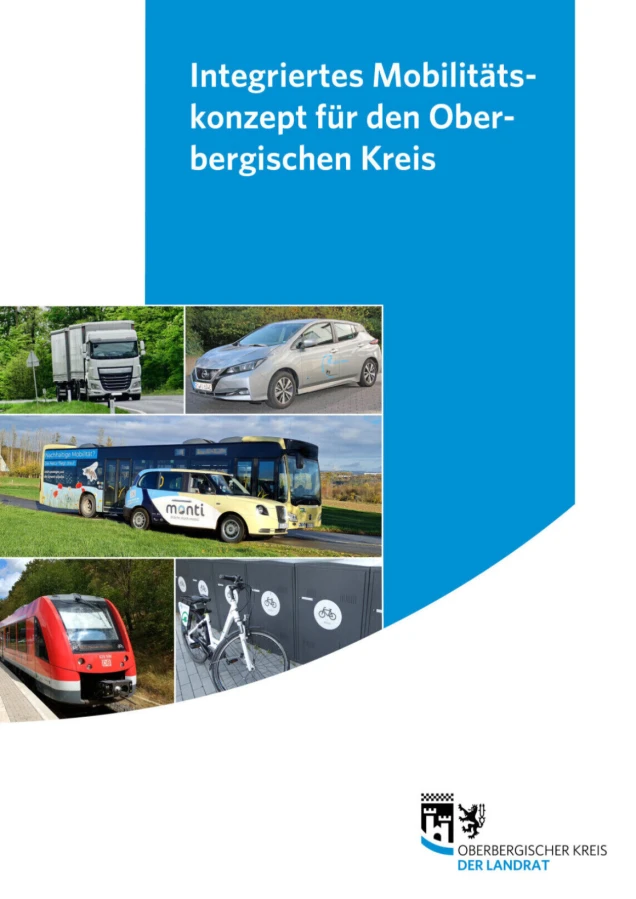
The Oberberg District, in collaboration with the municipalities belonging to the district and various stakeholders in the field of mobility, has developed an Integrated Mobility Concept for the Oberberg District to devise sustainable solutions for traffic planning. This will allow mobility in the district to be designed more efficiently, environmentally friendly, and user-oriented.
The Integrated Mobility Concept serves as a strategic guide to address the challenges of future traffic planning in a rural area. It aims to promote sustainable mobility options and optimize traffic structures to meet the current and future needs of the population.
From the outset, realistic implementation and financial feasibility of the measures were taken into account. On June 12, 2025, the district council adopted the Integrated Mobility Concept for the Oberberg District.
Goals, fields of action, and measures
Based on the household survey and online participation, the Oberberg District and the participating stakeholders developed goals for mobility development in the Oberberg District.
On June 20, 2024, the district council of the Oberberg District adopted the following goals and fields of action as a first step, which formed the basis for developing the measures for the Integrated Mobility Concept for the Oberberg District.
Some objectives hold particular significance for the Oberberg District (bold text):
-
Preserve and secure transport infrastructures
-
Fundamentally strengthen mobility for the location and living conditions in the Oberberg District and contribute to securing skilled labor
-
Maintain and concentrate mobility offerings
-
Design mobility offerings to be affordable and feasible
-
Reduce CO₂ emissions in the mobility sector
-
Integrate settlement development and mobility
-
Strengthen shared use of existing infrastructures
-
Increase the use of environmentally friendly transport modes
-
Reduce, avoid, and shift motorized individual transport
-
Improve accessibility to centers and strengthen local supply
-
Promote equal consideration of transport modes
Under the aforementioned overarching goals, the mobility concept is divided into six fields of action:
-
Motorized Individual Transport (MIT)
-
Mobility and Economy
-
Public Transport (PT)
-
Cycling
-
Multimodality
-
Communication and Networks
In addition, each field of action is assigned further specific field goals. Measures are being developed to achieve the goals.
Motorized Individual Transport (MIT)
-
Enable alternatives to second cars
-
Reduce MIT trips over short distances and to main commuter destinations
-
Improve regional traffic flow
-
Expand electromobility
-
Increase car occupancy rates
Mobility and Economy
-
Improve framework conditions for goods and delivery traffic
-
Ensure the performance of transport infrastructure
-
Enhance accessibility of commercial locations through the environmental network
-
Strengthen corporate mobility management
-
Create framework conditions for autonomous mobility solutions
Public Transport (PT)
-
Ensure the current public transport line network
-
Develop on-demand services further ("Future monti")
-
Strengthen and qualify main routes
-
Improve accessibility to public transport
-
Expand rail infrastructure
-
Promote the use of emission-free buses
-
Fundamentally structure "student transport lines"
-
Demand-oriented and small-scale services for area development
-
Create framework conditions for autonomous mobility
Cycling
-
Improve framework conditions for cycling development
-
Support the implementation of planned measures
-
Improve safety in cycling
-
Combine everyday and leisure cycling more effectively
-
Implement the "Regional Cycling Infrastructure Concept"
Multimodality
-
Improve the integration of transport modes
-
Expand mobility stations
-
Strengthen framework conditions for local mobility/last mile
-
Enhance multimodal information options
-
Support sharing offers
Communication and Networks
-
Strengthen communication of sustainable mobility
-
Enhance interest in infrastructure developments
-
Promote regional and district-wide exchange
-
Improve the cross-regional usability of systems
-
Make communication more citizen-focused and target-group-specific
-
Simplify and accelerate administrative processes
The Integrated Mobility Concept for the Oberbergischer Kreis from page 107 contains 45 different measures across six fields of action. Five of these were directly approved by the district council as starter measures.
Motorized Individual Transport (MIT)
-
Carsharing Oberberg
-
Village cars and volunteer driving services
-
Electromobility advisory center
-
Charging infrastructure at district-owned properties
-
Expansion and maintenance program for the district road network in Oberbergischer Kreis
Mobility and Economy
-
Connection of industrial sites for economic traffic
-
Optimization of logistics and heavy goods traffic
-
Connection of industrial sites with environmentally friendly transport systems
-
Corporate mobility management for companies and industrial sites
-
Qualification of goods transshipment at Osberghausen
-
Autonomous economic traffic and processes
Public Transport (PT)
-
Update of the public transport plan
-
Further development of primary lines and main axes in PT
-
Express bus services in PT
-
Demand-oriented service development and adjustment, expansion, and reduction of services
-
Improvement of connections to leisure destinations and essential services
-
Development of PT acceleration measures
-
Future concept monti
-
Expansion of Oberbergische Bahn to S-Bahn
-
Reactivation of railway lines for local rail transport
-
Conversion of OVAG bus fleet to sustainably powered buses
-
Potential efficiency improvements in PT for school transport
-
Pilot project for on-demand school transport
-
Adjustment, expansion, or reduction of service forms for line taxis and taxi buses
-
Alternative offers from the taxi industry in PT
-
Further development and qualification of the citizen bus service in Oberberg
-
Examination of night bus service development
-
Testing the use of autonomous vehicles in PT
Cycling
-
Tourist cycling mobility and leisure cycling
-
Establishment of a district-wide e-bike rental system
-
Development and qualification of cycling paths
-
Creation of implementation structures
-
Cycling monitoring
Multimodality
-
Implementation of detailed concept for mobility stations
-
Development of stops
-
Park + Bike & Ride offers
-
Further development of OVAG app into a multimodal information system
-
Digital traffic sign register
-
Connection of OBK to the long-distance bus network
Communication and Networks
-
Mobility network Oberberg
-
Qualification of internal administrative exchange formats
-
Further development of memberships in mobility-promoting institutions
-
Further development of district-owned and municipal companies
-
Communication and target group-specific actions and advisory services
-
Combined tickets and marketing for leisure transport
Household Survey
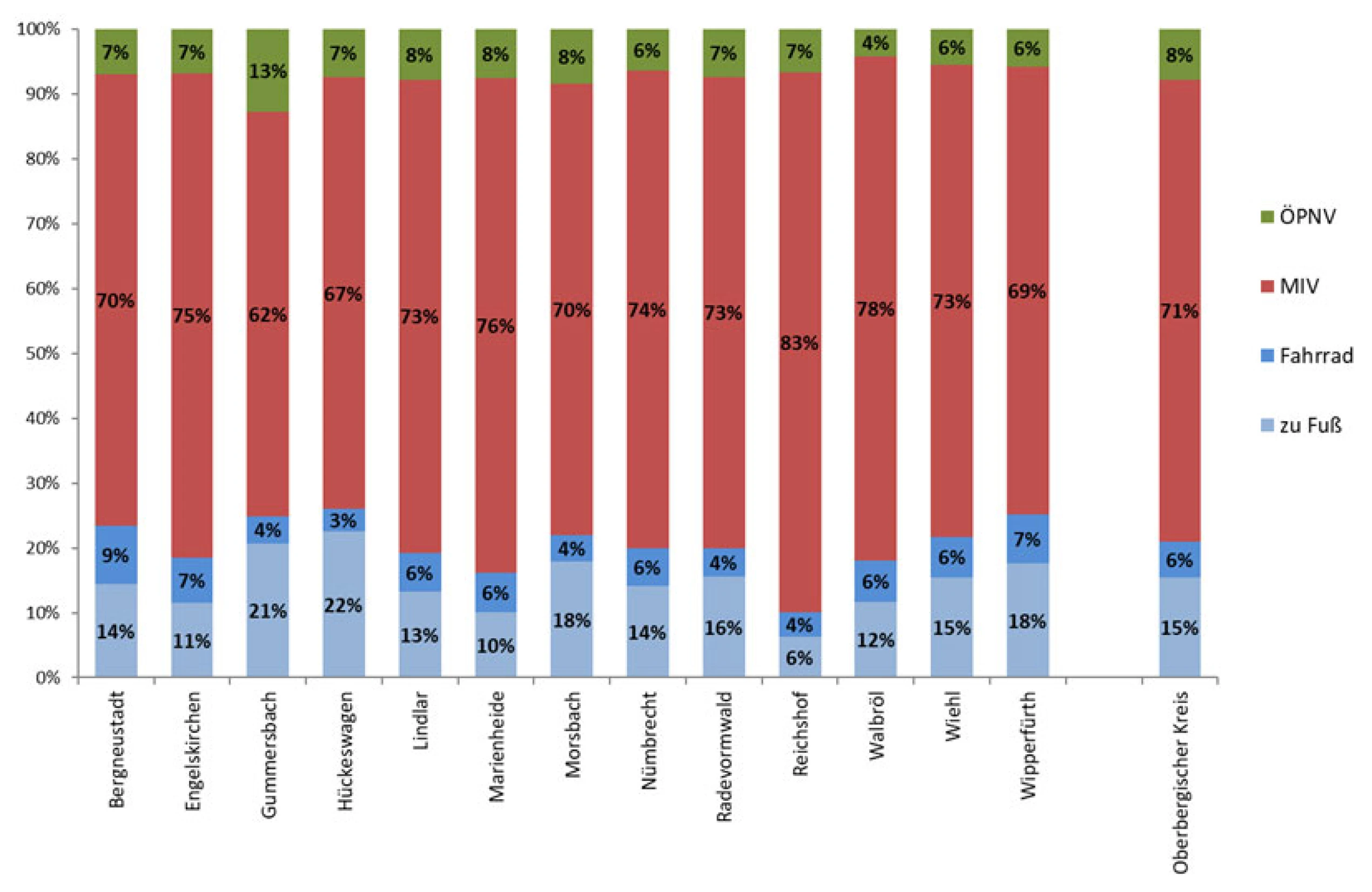
3,628 individuals from 1,792 randomly selected households participated in the survey on mobility behavior in spring 2023. This results in meaningful findings for the Oberberg District as well as for its cities and municipalities.
Evaluation of Modal Split (share of individual modes of transport in total traffic):
- 70% of trips in the Oberberg District are made by car.
- 8% of trips are made by bus and train.
- 21% of trips in the Oberberg District are made either on foot (15%) or by bicycle (6%), with approximately 3% accounted for by pedelecs/e-bikes alone.
- The share of public transport (ÖPNV) is above average, especially in Gummersbach.
- The shares of motorized individual transport (MIV) are highest among residents of Reichshof and Waldbröl.
Evaluation by cities and municipalities in the Oberberg District
Online participation
1,264 entries with suggestions and proposals were submitted by 405 citizens in spring 2023 via online participation into the development process.
Excerpt from the comments:
- Car traffic:
Increasing traffic safety, speed reduction - Bus and rail traffic:
Better connection to the northern district, express buses, buses and trains should run more frequently (especially in the evening) - Truck traffic:
Keeping trucks out of residential areas and town centers - Cycling:
Development of cycle paths between municipalities, improving the condition of cycle paths, creation of higher-quality parking facilities at stops, improving traffic safety - Pedestrian traffic:
Pedestrian traffic and parking (stationary traffic) are the responsibility of the cities and municipalities. Therefore, the online comments were forwarded to the municipalities.
Map with location of suggestions and proposals
Note:
Suggestions affecting the entire district area are collectively represented at a point near Meinerzhagen (northeast of Gummersbach).
Contact
Michael Tünker
Karlstr. 14-16
2.Obergeschoss, Raum: 204
51643 Gummersbach
Lydia Winter
Karlstr. 14-16
2.Obergeschoss, Raum: 214
51643 Gummersbach
