 copyright: OBK
Naturalisation
Through naturalization, foreigners acquire German citizenship and gain all rights and obligations as citizens.
This page was translated from German using artificial intelligence. The translation may contain errors or inaccuracies. In case of doubt, the German original version prevails.
Upon successful naturalization, the following rights apply:
-
General voting rights.
-
Acquisition of so-called basic rights for Germans.
(Art. 8 GG: Freedom of assembly, Art. 9 Para. 1 GG: Freedom of association, Art. 11 GG: Freedom of movement, Art. 12 GG: Freedom of occupation) -
Inviolable right of residence.
-
Access to civil servant status.
-
EU freedom of movement.
-
Consular protection abroad.
-
Visa-free travel to many countries worldwide.
The naturalisation procedure
Naturalisation takes place upon application. Every applicant for naturalisation who has reached the age of 16 must submit their own naturalisation application. For persons under legal guardianship, a guardian's certificate must be submitted or, if the guardianship was established before 2022, a certificate of appointment as proof of legal guardianship.
The application is submitted at the town hall (citizens' service office, in some cases also the registry office) of the respective place of residence. There, the applicant for naturalisation receives the application form, which must also be signed there in the presence of an official. This certifies the signature. Applicants for naturalisation also receive a list of the documents to be submitted there.
For children and young people under 16 years of age, both parents must submit and sign the application. In the case of sole custody, this must be proven (negative certificate from the Youth Welfare Office or a court decision on custody).
The complete application is then forwarded by the city or municipality. The applicant for naturalisation subsequently receives a confirmation of receipt requesting payment of the advance fee (€191). Once the fee has been received, the nationality authority begins a comprehensive review of the application. A so-called security check is carried out with various security authorities, and depending on the individual case, information is obtained from other authorities or public bodies.
In addition, the foreigner's file is evaluated to determine whether the applicant holds a residence permit suitable for naturalisation and whether the required minimum periods of residence have been fulfilled.
Once all requirements for naturalisation have been confirmed as met, a naturalisation certificate is issued and ceremonially handed over during a personal appointment. Upon receipt of the naturalisation certificate, the applicant acquires German citizenship. The naturalisation certificate is a unique document and serves as proof of the acquisition of German citizenship.
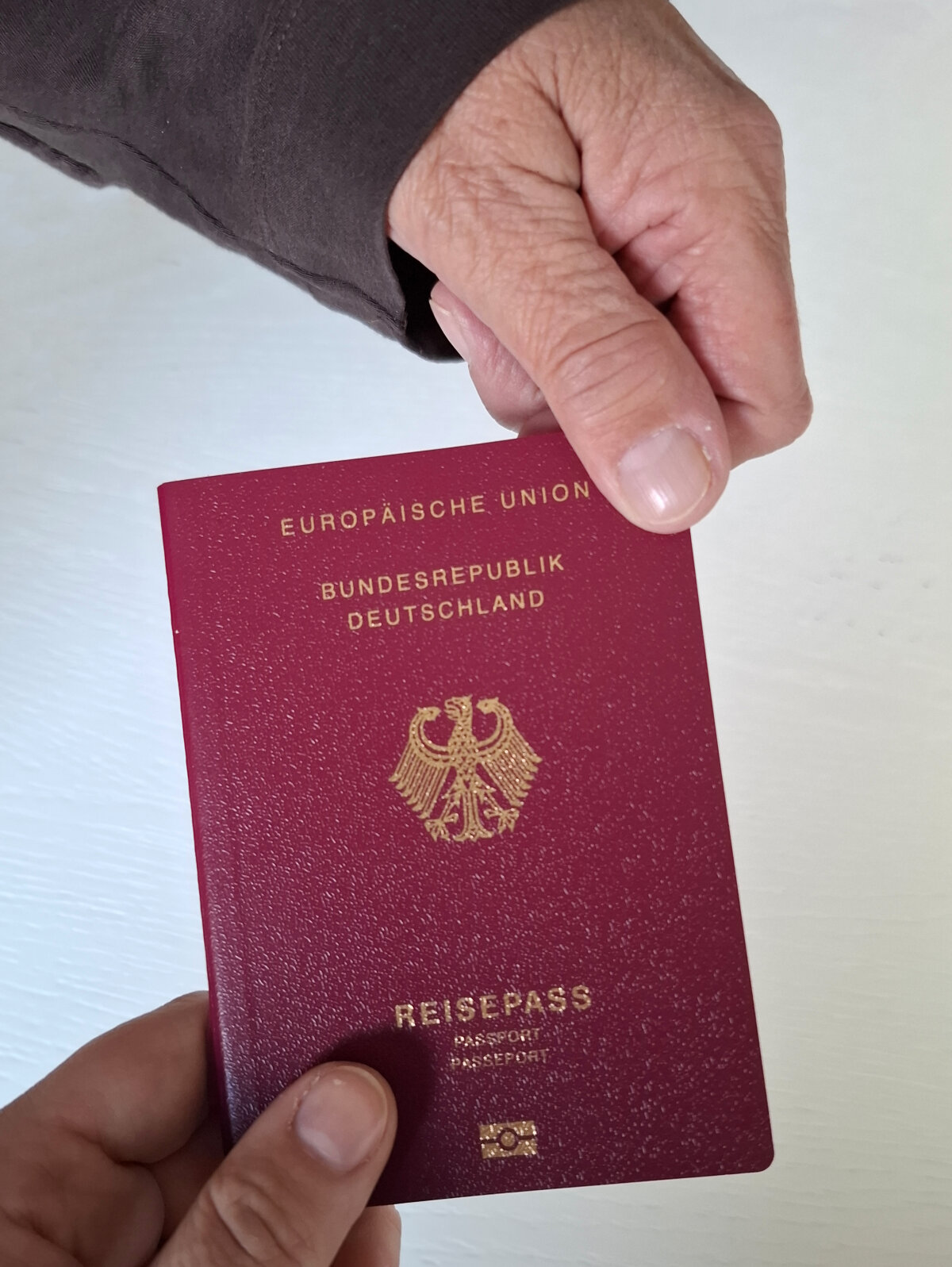
With the naturalisation certificate, German identity documents (identity card and passport) can then be applied for at the citizens' service office of the respective place of residence.
Naturalization Requirements
With the entry into force of the Act to Modernize Citizenship Law on June 27, 2024, it will no longer be required to renounce one's previous citizenship.
Dual citizenship will generally be accepted.
-
Five years of lawful and habitual residence in Germany.
-
Verified identity and citizenship.
-
Permanent or long-term residence permit at the time of naturalization.
-
Commitment to the liberal democratic basic order/Commitment to Germany's special historical responsibility for the Nazi regime (Declaration of loyalty).
-
Securing one's livelihood and that of dependents without receiving basic security benefits (SGB II), social assistance, or basic security (SGB XII).
-
No conviction for a criminal offense.
-
Proof of German language skills equivalent to level B1 of the Common European Framework of Reference for Languages.
-
Proof of knowledge of Germany's legal and social system and living conditions (Naturalization test/Test Life in Germany).
-
No simultaneous marriage to multiple spouses.
-
Respect for the equality of men and women as stipulated in the Basic Law.
Required Documents
Proof of identity, nationality, and residence status
-
valid home country passport, ID (e.g., travel document for refugees) or substitute ID
-
electronic residence permit (eAT)
-
expired home country passport and/or identity card
Proof of identity and marital status
-
own birth certificate (for foreign certificates, always with a translation by a translator authorized for German courts)
-
birth certificate of children/spouse to be naturalized
-
marriage certificate or German marriage certificate
-
divorce decree / death certificate of the former spouse
Proof of sufficient German language skills
Proof of civic knowledge
Proof of income for employeesEmployer certificate
In individual cases, additional documents may be required, such as:
-
for self-employed individuals: proof of health insurance coverage and adequate private retirement provision, clearance certificate from the city/municipality and tax office, extract from the debtor register, income tax notice, etc.
-
proof of custody/legal representation, e.g., negative certificate from the youth welfare office, custody decree, guardian ID, etc.
-
proof of the existence or non-existence of other nationalities
Download
Information sheet on loss of citizenship
Information sheet on the declaration of loyalty
Information sheet on exemption from punishment
Information sheet: documents
Information sheet on securing one's livelihood
Information sheet on civic knowledge
Information sheet on periods of residence in Germany
Information sheet on clarified identity
Information sheet on the declaration of special responsibility
Information sheet on sufficient knowledge of German
Declaration of historical responsibility
Declaration of loyalty – Commitment to the free democratic basic order
Employer's certificate
Declaration of inclusion for co-naturalisation
Contact
Naturalisation
(Responsibility according to surname)
Ms. Amamra (A - J)
Ms. Akgün (K - Z)
