Integration through language
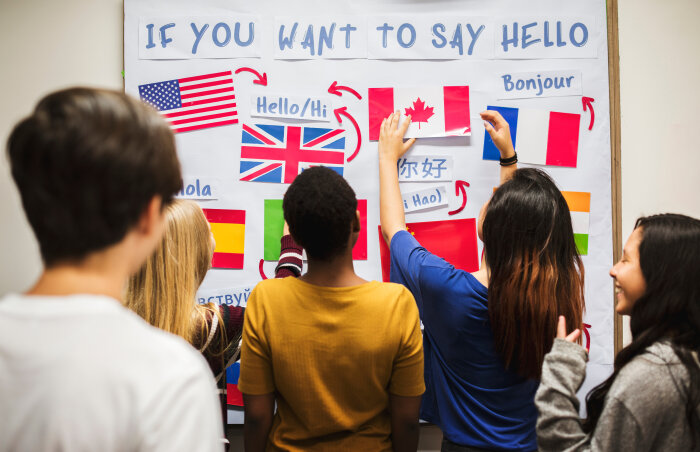
Teenager people at the national flags board
Automatic Translation

This page was translated from German using artificial intelligence. The translation may contain errors or inaccuracies. In case of doubt, the German original version prevails.

Language course providers

An important cooperation regarding the linguistic integration of refugees in the Oberberg district exists between the Municipal Integration Center (KI) of the Oberberg district and the Regional Coordination Cologne of the Federal Office for Migration and Refugees (BAMF).

The KI, alongside local integration course providers, providers of job-related German language promotion, the Federal Employment Agency, and the Jobcenter Oberberg, is part of a comprehensive network.

Downloads and links

Overview of integration course providers

Overview of vocational language course providers

Language mediation: Lay interpreter pool

Interpreters are volunteers who interpret throughout the district to facilitate communication between newcomers with little or no German language skills and institutions. These lay interpreters are recruited and trained by the Municipal Integration Center (KI). The qualification does not entitle one to professional interpreting activities. The NRW state government promotes the establishment of such lay interpreter pools through the municipal integration centers.

Language mediation

Support through interpretation: A quick guide for professionals

Multilingualism in healthcare

Concept of Lay Interpreter Pool in Oberbergischer Kreis

Frequently asked questions from professionals

Anyone who meets the requirements can fundamentally become a language mediator in the OBK. Through mandatory qualification, volunteers are prepared for their assignments. Institutions have the opportunity to introduce themselves and their tasks during the training (if you would like to revise your introduction or if your institution wants to take advantage of this offer and has not submitted anything yet, feel free to contact sprachmittler@obk.de). 
The active lay language mediators are continuously accompanied by the KI. Regular exchange meetings are convened as part of this, which are intended both for sharing experiences and, if necessary, for supervision. The KI identifies training needs based on the experience reports of the language mediators and trains the volunteers twice a year. Moreover, the responsible staff are continuously available to language mediators and institutions as contact persons. The Municipal Integration Center regularly evaluates the most common areas of use for language mediators to derive further training needs.

In principle, the following institutions can use the lay interpreting service in the Oberberg district free of charge:

  • Daycare centers, kindergartens, schools, universities
  • Municipal authorities such as housing offices, school administrations, etc.
  • Institutions in the social and integration sectors as well as counseling centers
  • Non-profit organizations, such as volunteer initiatives or migrant self-organizations

The KI reserves the right to decline assignments that could lead to significant emotional strain for the volunteers. There is no legal entitlement to an assignment within the framework of the interpreter pool.

The use of lay interpreters from the language mediator pools of the Municipal Integration Center (KI) OBK is completely excluded in the following contexts:

  • Assignments from private individuals (apartment viewings, private meetings, etc.)
  • Assignments from other private institutions (companies, job interviews, etc.)
  • Conversations with legal consequences, e.g., (legal) attorneys, notaries, marriages, or police statements
  • Child welfare endangerment (§8a), protective custody, etc.
  • Assignments related to the preparation of health reports, such as medical examinations of travel fitness
  • Assignments from educational institutions to determine special educational support needs (e.g., so-called AO-SF procedures)
  • Medical appointments of any kind
  • Continuous accompaniment over a longer period (e.g., school accompaniment)

If you are unsure whether your institution can use the help of volunteer language mediators, feel free to contact sprachmittler@obk.de

The KI reserves the right to reject assignments that could lead to an enormous emotional burden on volunteers. There is no legal entitlement to an assignment within the framework of the language mediator pool.

The Municipal Integration Center OBK covers the expense allowances for assignments in institutions that do not have their own funds available for translations.

Institutions that have the option to finance the use of language mediators through an internal budget cannot, due to the funding guidelines of the state government, claim financing via the KI funding allowance. A prerequisite for cost coverage is prior registration of the appointment through the online form.

This applies as long as the funding allowance for financing assignments from the lay language mediator pool is available. If the funds are exhausted, no further assignments can be financed by the KI. Should this occur, the KI will provide timely notification.

Appointments that are not registered cannot be invoiced.

If you need interpreters, you can submit the request via the online form. In this form, we ask for the following information, among other things:

  • Location of the assignment (possibly also telephone assignment or via video)
  • Requesting institution
  • Contact person for inquiries
  • Information about the conversation (e.g., country of origin and language/dialect of the individuals seeking advice, possibly additional sociocultural information)

The responsible staff will then provide you with contact information for suitable interpreters. You will handle organizational arrangements and, if necessary, a brief preliminary conversation for preparation with the volunteers yourself.
If the interpreters agree to take on the requested appointment, it is necessary to register the appointment in advance via the online form at the Municipal Integration Center. Without prior registration via email, no costs can be reimbursed.

Important: Registration via email cannot be considered; the registration must be done using the provided online form!

If an institution already has contact information for interpreters from previous assignments, it can request appointments with the relevant volunteers without prior contact with the Municipal Integration Center. However, registering the upcoming appointment is mandatory to ensure coordination by the Integration Center.

In principle, it is possible to request interpreters on short notice for appointments. However, since these are volunteers, they are not obligated to accept requests. All volunteers are free to decline requests without giving reasons. To successfully arrange interpreters, it is requested to submit inquiries as far in advance as possible.

Of course, all interpreters work differently, but there are still some overarching points that can simplify the conversation for both you and the interpreters:

  • Speak slowly and clearly. Take regular breaks so that the interpreters have time to translate.
  • Avoid using too many or overly complex foreign words.
  • The responsibility for the conversation remains with the professional. Avoid assigning tasks to the interpreters (“Please explain to the clients now how to apply for child benefits.”).
  • Provide interpreters with feedback on the translation.

Note that interpreters are instructed to translate everything that is said. This also means that you should not try to “get interpreters on your side” (“Don’t you also think the clients are being very rude?”).

However, the general rule is:

Ask the interpreters directly what they need!

The task of interpreters is to interpret, not to advise!

The language mediators are aware of the importance of data protection and confidentiality. All language mediators also sign a confidentiality agreement at the beginning of their activity and must adhere to it. 

Frequently Asked Questions for Interested Volunteers

Do you have knowledge of several languages and would like to use them to support refugees or newly immigrated people during appointments? Then we are very excited to meet you! Contact us at sprachmittler@obk.de and as soon as a new qualification starts with an available spot, we will gladly invite you.


The training takes place online, mostly through self-study. There are regular online meetings via Zoom where we introduce the project and you can ask your questions. You will have a total of 4 weeks to work on the training materials. Most participants finish earlier; the 4 weeks are merely intended to give you enough time to manage the content independently and at your own pace.

After successfully completing the qualification, you will receive a certificate of participation from us and can then volunteer as a language mediator!

In various modules, you will learn the most important basics for interpreting. These include topics such as understanding the role of interpreters, confidentiality, communication basics, and some practical tips, as well as an overview of counseling centers in the Oberberg district that frequently work with volunteer interpreters and the education system in Germany, which are part of the training content.

You will learn above all what is important in interpreting and how you can implement this in practice.

If you successfully complete the qualification, you will sign a framework agreement with us for voluntary activity and submit an extended certificate of conduct. As soon as both are available to us, you can take on assignments!

Our language mediation team is always available to assist you with any questions. Whether you feel unsure before your assignment and want to talk to us, or whether you want to share your experiences afterward.

Twice a year, you must attend a training session to address questions that arise in practice and to ensure the quality of interpreting. These sessions are organized and offered by us and are tailored to your needs and interests.

You must be at least 18 years old. Your German language skills should be at least at level B2, as should your knowledge of the target language.

Since language mediators are primarily used in counseling centers, daycare centers, schools, and similar institutions, you should bring a certain degree of flexibility during regular office hours: If you work full-time from 8 a.m. to 4 p.m. and are only available on weekends, you will not be able to take assignments.

A certain mobility in the Oberbergischer Kreis is also desirable so that you can reach the assignments and appointments.

Since this is a voluntary activity, we pay you an expense allowance. This currently amounts to 20€/h. Your travel expenses are reimbursed at 0.30€/km.

You can receive a maximum of the legally allowed volunteer allowance of currently 840€/year. Beyond this, we cannot pay you any additional funds and will no longer assign you.

How many assignments you have depends partly on you and partly on your language.

Some languages are more “in demand” than others depending on the political situation and are requested more frequently. However, whether you want to accept the request or not is up to you. You are not obliged to take on appointments and can decline at any time without giving reasons.

Some of our interpreters only work every few months, while others work multiple times a month. You can decide for yourself how many of the assignments presented to you you want to take on.

We are very pleased about your interest! You are welcome to register for the training and get a good insight into the activity as a language mediator. Some of our active language mediators have agreed to accompany new language mediators to an appointment so that you can watch how such an appointment works.

If you realize that you do not enjoy the activity, you can stop at any time without providing reasons.

Some languages are more in demand than others, and for some languages, we already have many interpreters. If we can already foresee that we will not be able to mediate your language, for example because there are already enough people with these language skills, we will inform you of this.

Conversely, there are also some languages that are urgently needed. These include, in particular, Tigrinya, Somali, Sorani, Bulgarian, Arabic, Pashto, and Farsi/Dari.

Language promotion programs

For children and adolescents, there are various language promotion programs, which we inform you about on Bildung-in-Oberberg.

Your way to us:

Municipal Integration Center

Schützenstr. 13
51643 Gummersbach

Service Hours

Monday

08:00 AM - 12:00 PM
01:00 PM - 04:00 PM 

Tuesday

08:00 AM - 12:00 PM
01:00 PM - 04:00 PM 

Wednesday

08:00 AM - 12:00 PM
01:00 PM - 04:00 PM 

Thursday

08:00 AM - 12:00 PM
01:00 PM - 05:30 PM 

Friday

08:00 AM - 12:00 PM