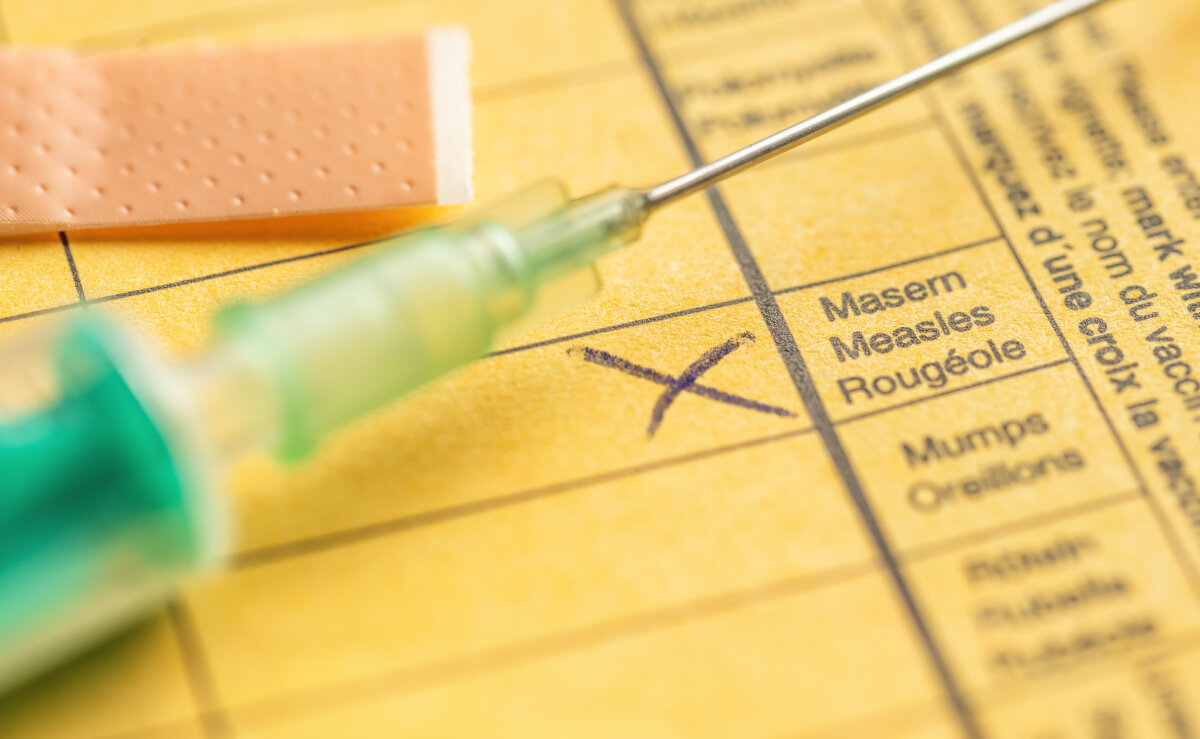
 copyright: Boris Zerwann
Measles Protection Act
This page was translated from German using artificial intelligence. The translation may contain errors or inaccuracies. In case of doubt, the German original version prevails.
The Measles Protection Act has been in force since 1 March 2020.
All persons born after 1970 who are cared for or work, or are to be cared for or start working, in a community facility (e.g. school, daycare centre) must provide proof of adequate vaccination protection against measles. This also applies to persons who have already been cared for in a children's home for four weeks or are accommodated in refugee housing, as well as to those working in the aforementioned facilities and in healthcare facilities. Section 20(8) et seq. of the Infection Protection Act lists all affected groups of persons again.
Please report to the Health Office, using the notification form, at infektion@obk.de only those persons who have not provided proof of adequate vaccination protection or no immunity against measles.
The following information is required:
-
Surname, first name, date of birth, address of the person cared for or employed
-
if applicable, surname and first name of the parents
-
date of the start of care/employment
-
exact vaccination status (number of vaccinations)
Further Information
You can find further information on measles and the Measles Protection Act on the linked websites and downloadable documents on the right.
You will also find documentation aids on the Measles Protection Act for community facilities on the right.
General questions on the topic of measles:
Measles is caused by viruses and occurs worldwide. It is highly contagious. A measles infection is not a harmless disease, as complications occur in roughly one in ten of those affected. In Germany, the incidence of measles has declined sharply due to vaccinations. Nevertheless, clusters of cases repeatedly occur among unprotected persons. This also affects adolescents and young adults, so it can no longer be described as a childhood disease.
At the onset of measles, symptoms such as high fever, coughing and a runny nose appear, along with inflammation of the nasal and pharyngeal passages and conjunctivitis. Only after a few days does the typical rash appear, starting on the face and behind the ears before spreading over the entire body. The rash is accompanied by a renewed rise in fever and subsides after 3 to 4 days. This can be accompanied by skin peeling.
Measles temporarily weakens the immune system, making it harder to fend off other pathogens. This can lead to complications, often caused by additional pathogens, such as middle ear infections, respiratory infections or pneumonia.
A particularly feared complication of measles is encephalitis. It occurs in about one in 1,000 measles cases. 10% to 20% of those affected die from it. In 20% to 30%, severe long-term damage such as intellectual disabilities or paralysis remains. Very rarely, several years after a measles infection, a condition known as SSPE (subacute sclerosing panencephalitis) occurs. SSPE is a progressive inflammation of the brain and nervous system and is always fatal. Children who contracted measles in their first year of life are particularly affected.
Yes, even a suspected case is subject to mandatory reporting. The reporting obligation lies with the treating physician.
Measles viruses are transmitted exclusively from person to person. Almost any contact between an unprotected person and someone infected leads to transmission, even from a distance of several metres. When coughing, sneezing or talking, the pathogens can spread through the air in small saliva droplets and be inhaled
Through vaccination.
The Standing Committee on Vaccination (STIKO) recommends vaccination against measles. It should preferably be given as a combined MMR vaccine, which protects against mumps and rubella in addition to measles.
For children, building up vaccination protection in two steps is recommended: the first vaccination should be given at 11 to 14 months of age, and the second at least 4 weeks after the first and by the end of the second year of life at the latest. Only then is the recommended vaccination series for protection against measles complete. The first MMR vaccination can conveniently be given as part of the U6 early detection examination. The first MMR vaccination can already be given from the age of 9 months if the child is admitted to a community facility before completing 11 months of age.
For unvaccinated children and adolescents, vaccination should be caught up as soon as possible with two doses.
Adults born after 1970 are recommended to be vaccinated if they were not vaccinated at all against measles or were vaccinated only once in childhood. This also applies if the vaccination status is unclear. They receive a single vaccination.
For employees in the health service or in community facilities born after 1970, such as staff at kindergartens or schools, or employees who care for people with severely weakened immune systems, as well as for those cared for in community facilities, there has been a legal obligation to be vaccinated against measles since 1 March 2020, if they were not vaccinated at all or only once in childhood or if the vaccination status is unclear (for details, see the Measles Protection Act).
Anyone who has had contact with a person with measles and is not protected should, if possible, receive an MMR vaccination as a so-called post-exposure vaccination within 3 days. Infants from the age of 9 months can also be vaccinated if there is a risk of infection. This can, in some circumstances, still prevent the outbreak of the disease or reduce its severity. For contact persons who are not permitted to receive the MMR vaccine (e.g. infants under 6 months and pregnant women), there is, according to STIKO recommendations, the option of temporary prevention of infection using antibodies (immunoglobulins).
Contact persons of people with measles who are not fully vaccinated or have not had the disease are not permitted to attend community facilities under the Infection Protection Act. The Health Office can temporarily exclude unprotected persons from the community facility.
The community facility may only be attended if:
-
complete vaccination protection is documented in the vaccination record
-
or the post-exposure vaccination was given within 3 days (does not apply to contact persons living in a shared household with a person with measles)
-
or protection against measles has been confirmed by a laboratory test.
See section "How can I protect myself".
No, if you know for certain that you have already had measles, you are immune.
Vaccination does not provide 100% protection. Vaccinated people who contract measles often experience a much milder course of illness with fewer complications.
After having had a measles infection, immunity is present.
No, no transfer takes place in this case.
See section "How can I protect myself".
This is decided on a case-by-case basis and must be discussed with the doctor.
Adequate immunisation (two vaccinations) provides lifelong protection. Even a single vaccination already provides lifelong protection of over 90%.
The measles-mumps-rubella vaccination does not need to be regularly refreshed.
The health department currently only records and advises direct contact persons of infected individuals. Contacts of contacts are currently not affected and do not need to take any special precautions. Working in social professions remains possible, unless the person is an unvaccinated direct contact. However, this is certainly a good opportunity to get vaccinated now.
The basis for this is a federal law, the Infection Protection Act (IfSG).
In particular, Section 16 on the prevention of communicable diseases, Section 25 on investigations into communicable diseases, and Section 29 on the observation of persons who have a contagious disease or are suspected of having contracted pathogens, govern the responsibilities of the health department here.
Data protection and, under certain conditions, fundamental rights (such as entering a dwelling, etc.) can be restricted on this legal basis.
Currently there is no reason not to attend such events. There are no indications that a generally increased risk of infection is to be expected.
There is currently no recommendation not to leave the house with unvaccinated persons. However, according to the Measles Protection Act, since 01.03.2020 only persons with full vaccination protection against measles may attend a kindergarten or school. For kindergartens, this leads to exclusion from care; for schools, due to compulsory schooling, it may lead to a fine (for details, see the Measles Protection Act). Should measles cases occur in community facilities, you will be informed promptly.
No, there is no scientific evidence for this. In 1998, A.J. Wakefield, together with other scientists, published a study suggesting a link between the measles vaccination and gastrointestinal symptoms as well as developmental disorders in twelve children. Further studies were also unable to confirm these findings. It was proven that Wakefield had deliberately falsified data. The corresponding publication was retracted and his medical licence was revoked.
The first symptoms usually appear about 8 to 10 days after infection. It usually takes 2 weeks until the typical rash breaks out. Infected persons are already contagious about 3 to 5 days before the rash becomes visible. After the rash appears, a person remains contagious for a further 4 days. Anyone who has recovered from measles is protected for life against a new infection.
Contact
Infection control, environmental medicine, notifiable diseases
