 copyright: RIO OBK
Building planning law
This page was translated from German using artificial intelligence. The translation may contain errors or inaccuracies. In case of doubt, the German original version prevails.
Where can I build? What can I build? These questions about planning law are essentially regulated in the Building Code (BauGB).
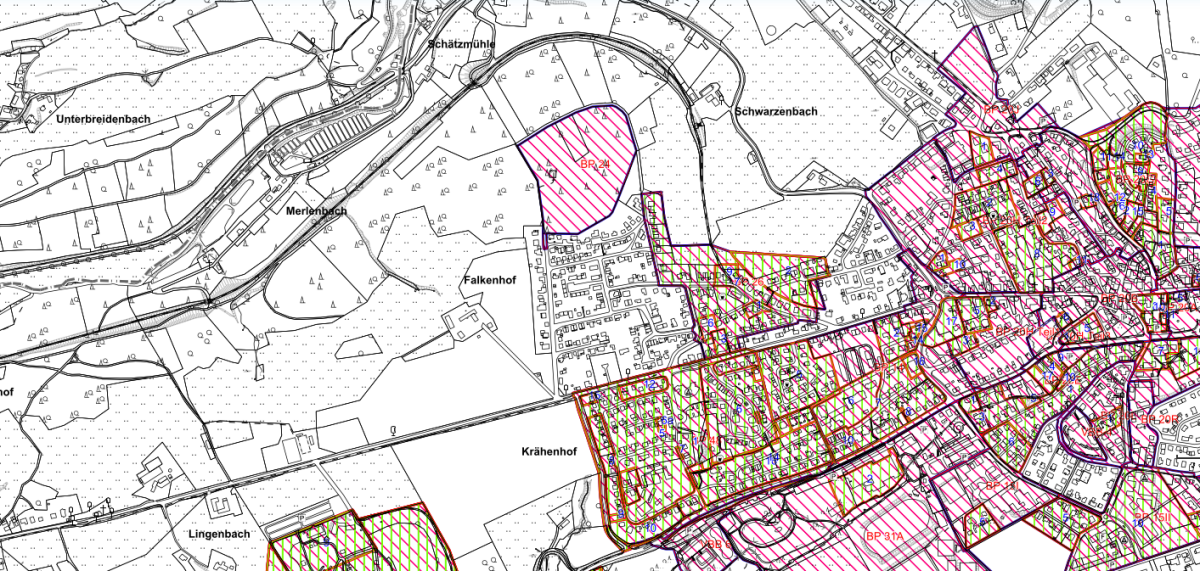
A city or municipality can control construction activities through land-use planning. For this, the land-use plan (preparatory land-use plan) and the development plan (binding land-use plan) are available.
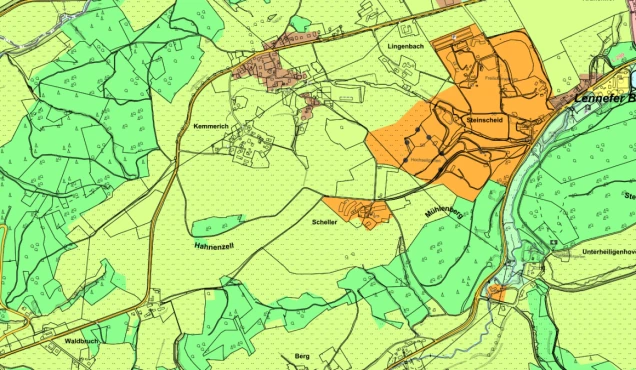
Land Use Plan
The land use plan covers the entire municipal area and shows how the city or municipality plans to use the areas of its territory in the future. The areas are assigned to various usage possibilities, such as residential, commercial use, transportation, recreation, or landscape.
Whether the areas will actually be used for the specified purpose is not determined by the land use plan. This is only decided through a development plan based on it. Therefore, the land use plan does not give the property owner any legal claim to implement the usage depicted for their property.
A fixed procedure is prescribed for the creation of a land use plan, which also involves the participation of citizens.
The land use plan prepares the development plan.
Development plan
The city or municipality adopts a development plan if and when it deems it necessary for urban planning purposes. This allows it to regulate, for example, future development regarding:
-
permissible or impermissible types of businesses
-
number of stories or maximum building heights in meters
-
building boundaries for the positioning of the building on the property
-
locations for garages on the property
-
roof shapes or colors and materials for facade design
Your construction project is only permissible if it fully complies with the provisions of the development plan.
There is also a prescribed procedure for preparing or amending development plans, in which citizens participate. The draft plan is made available for inspection at the city or municipality for a certain period. If you have comments on the draft, you can contribute them to the process. The council later decides to what extent the comments of the citizens and specialist authorities will be followed.
The procedure ends with the adoption resolution. After that, the development plan becomes binding law.
Inner Area
If a construction project is located within a built-up area where a city or municipality has not established a development plan, it is referred to as the so-called inner area. The possibilities for development are regulated in § 34 of the Building Code (BauGB).
Not every built-up area is an inner area within the meaning of § 34 BauGB. Many of the hamlets and small villages in the Oberbergischer Kreis are scattered settlements that belong to the outer area.
In the inner area, the existing surroundings determine the limits of your construction project. It is permissible if it fits into the surroundings in terms of the type and scale of the building use and the location of the building on the property.
Examples
-
If there are two-story buildings there, you can also build two stories.
-
If there are residential buildings there, you can also construct a residential house.
-
If the front yards are 3 to 5 meters wide, your house can also be built at a distance of 3 to 5 meters from the street.
It is not always easy to clearly recognize the framework resulting from the surrounding development. Contact your advisors in good time, who will be happy to assist you.
Outer Area
If the location of a property within the scope of a development plan or in an inner area conveys a fundamental building right, there is a general construction ban in the outer area.
The protected open space in the outer area is primarily intended to preserve nature and landscape. Therefore, construction or a change in use of a building is only possible in narrowly defined special cases.
In the outer area, only projects that are strictly site-specific can be realized, such as buildings for quarry operations or agricultural and forestry enterprises. Other projects for residential purposes, leisure activities, or commercial use cannot be approved in the outer area.
There are exceptions for residential buildings or commercial enterprises legally constructed in the past, which can be carefully expanded under certain conditions.
If you wish to modify or renew such a protected existing building, consult your architect and your local contacts about the requirements. In these cases, it is advisable to have a preliminary building inquiry conducted to definitively check the fundamental approvability of your project.
