- News
- Service
- Topics
- The District
- Career
 copyright: OBK
Citizen survey on wind energy in Bergneustadt
This page was translated from German using artificial intelligence. The translation may contain errors or inaccuracies. In case of doubt, the German original version prevails.
In Bergneustadt, there are several areas where wind turbines can be installed. In the area around the Beulberg, the construction of three to four wind turbines is possible. The district council of the Oberbergischer Kreis and the city council of Bergneustadt can decide whether this area should be used for the construction of wind turbines and whether the planning legal framework should be created for it.
The opinion of Bergneustadt's citizens is needed:
Based on factual, understandable, and balanced information, the survey provides Bergneustadt's citizens with the opportunity to express their opinion on wind energy expansion in Bergneustadt.
The mailing of the documents to eligible voters will begin on October 6, 2026. Participation in the survey is possible until October 25, 2026.
The results of the survey are not legally binding. This means that the outcome does not dictate a final decision. The political committees will use the survey results as additional information for their deliberations.
In the area of Sülemicke, between Wiedenest and Belmicke, there is also the possibility of installing wind turbines. However, these areas are not the subject of the citizen survey.
Detailed information on the topic of wind energy in Bergneustadt is compiled in the questions and answers. Please feel free to inform yourself thoroughly before answering the two questions.
The city owns land in this area (3.1 ha out of a total of 26 ha) as well as the forest and economic pathways. A political resolution on the leasing of the land will be made in the council meeting in November. This explanation regarding Sülemicke is therefore merely for clarification purposes and offers no additional value.
Personal assessment on two questions
The citizen survey poses the following two questions, which relate to the respective responsibilities of the Oberbergischer Kreis and the city of Bergneustadt and can each be answered with Yes or No:
-
City of Bergneustadt
Do you generally support the possibility of creating the necessary planning requirements for the construction of one wind turbine east of Beulberg? -
Oberbergischer Kreis
Do you generally support the possibility of using the areas owned by the Oberbergischer Kreis in the Beulberg area for the construction of up to two wind turbines?
Explanation: The differing number of wind turbines and the separation of the questions are due to the following reasons:
The City of Bergneustadt can, after a resolution by the city council, designate a potential area for one wind turbine through an urban land-use planning procedure. This is the area outlined in red in the illustration. This area is owned by the Oberbergischer Kreis.
The urban land-use planning procedure is solely about a planning requirement. Whether the procedure would be successful and whether a wind turbine would indeed be constructed later is currently uncertain.
On the blue areas owned by the Oberbergischer Kreis, up to two wind turbines could be developed. These areas are designated wind energy zones where the construction of wind turbines is prioritized.
Map of wind energy zones in Bergneustadt
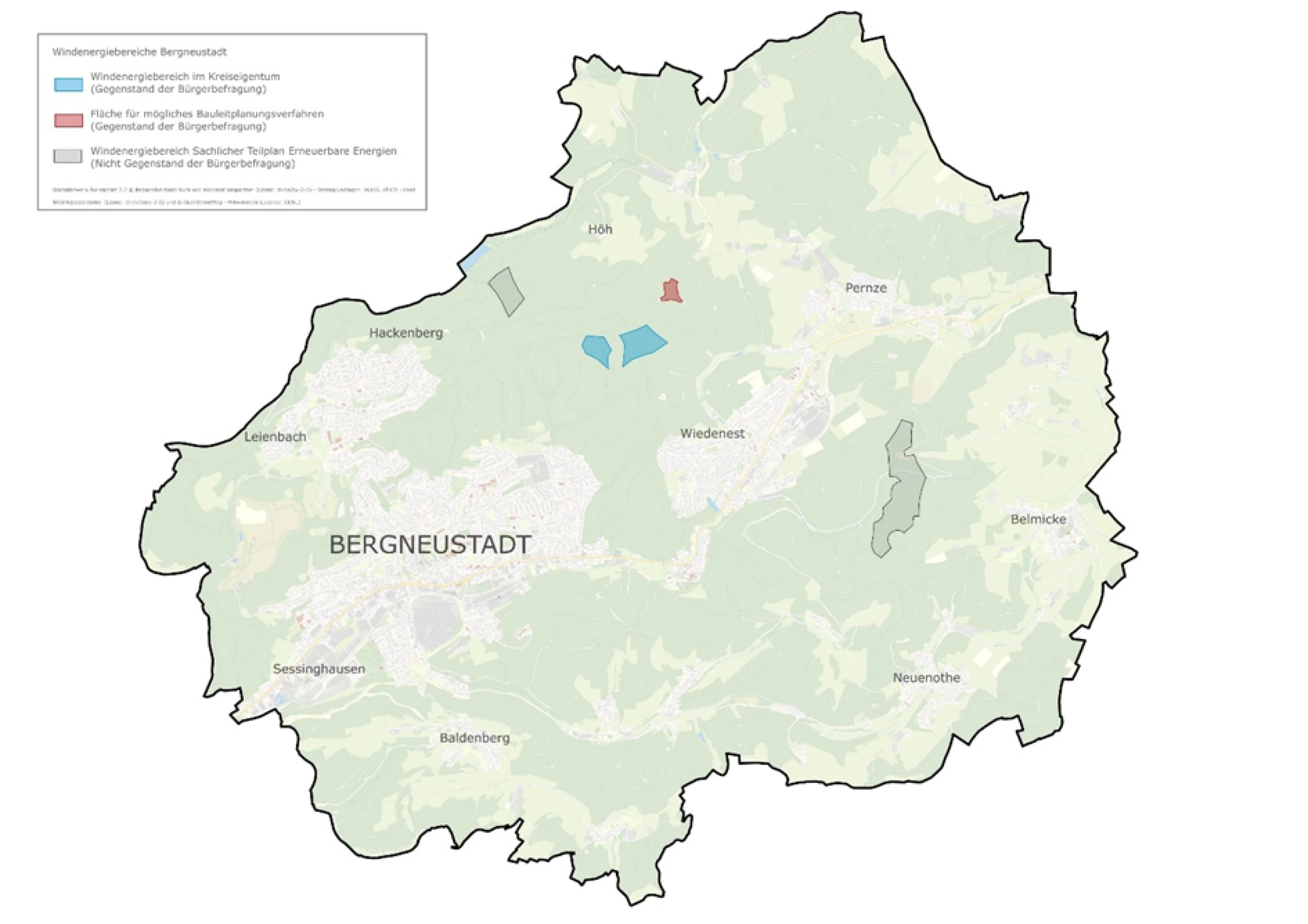
Wind energy areas in Bergneustadt: blue area - wind energy area on county property, red area - area for potential land-use planning procedures, gray area - wind energy area under the Renewable Energy Subplan (not subject to the citizen survey)
Key questions and answers regarding the potential wind turbines at Beulberg
The questions and answers are summarized by various categories and reflect the current planning status.
A) Citizen survey, process, and legal significance
The citizen survey aims to gather a perspective from the residents of Bergneustadt regarding the expansion of wind energy in Bergneustadt. Specifically, it concerns areas owned by the Oberbergische Kreis on Beulberg above the Aggertalsperre that are considered as priority wind energy zones for the installation of wind turbines, as well as an adjacent area, also owned by the Oberbergische Kreis, for which the city of Bergneustadt could create the necessary building and planning regulations to enable the installation of an additional wind turbine there.
The survey exclusively pertains to the areas on Beulberg owned by the Oberbergische Kreis or for which the city of Bergneustadt could establish planning rights. Private property owners in this area are not affected by the survey. They may develop their lands within the wind energy zones independently, following the applicable legal requirements and necessary planning and approval procedures for wind energy. No political decision by local committees is required for this.
The goal is to gather opinions from the citizens of Bergneustadt regarding the possibilities of wind energy utilization. The result is intended to serve as additional information for the responsible political committees for further discussions.
Subsequently, a second step could involve examining whether and under which technical and economic conditions wind energy utilization is feasible.
In a further step, it should be clarified how an economic participation of the citizens in the wind energy plants can be structured and which framework conditions should be considered for this.
Decisions on specific approval questions would only be made in further procedures.
All citizens of the city of Bergneustadt with German citizenship, as well as eligible voters from the other 26 EU member states who have reached the age of 16 on the day of the vote, have been residing or otherwise habitually present in the voting area of Bergneustadt for at least 16 days prior to the vote, and are not excluded from voting rights (see eligible voters for a municipal election), can participate in the survey.
Participation in the survey is voluntary.
The voluntary survey is possible both digitally and by submitting a ballot at the town hall of the city of Bergneustadt. The counting is carried out anonymously. The access options for digital voting and the ballot can be found in the cover letters.
It is also possible to answer only one of the two questions. The vote is still valid in this case. When participating using the paper questionnaires, a clear voter intent must be recognizable.
The implementation of the voluntary survey in Bergneustadt aims to define strategic objectives according to § 41 paragraph 1 letter u of the Municipal Code of North Rhine-Westphalia (NRW). This involves data transmission by the registration authority of Bergneustadt to fulfill a public task pursuant to § 34 of the Federal Registration Act. From a data protection perspective, the task constitutes a necessary processing for a task in the public interest (Article 6 paragraph 1 letter e of the EU General Data Protection Regulation).
The survey itself, as well as the printing and mailing of letters to citizens, was commissioned to “wer denkt was GmbH.” The city of Bergneustadt has entered into a data processing agreement with this service provider in accordance with Article 28 of the EU GDPR.
Key elements of the survey are:
-
The survey is based on the voluntary participation of citizens.
-
The “wer denkt was GmbH, Darmstadt” provides the results to the client only in anonymized form. It is not possible to trace back to individual persons.
-
Double participation is not possible as the individualized access codes can only be used once.
-
Participation is possible both online or in paper form. Responses submitted in paper form are subsequently digitized. If it turns out that the individualized access code of the paper questionnaire has already been used, data entry is not possible again. To verify these entries, all paper questionnaires are scanned and transmitted to “wer denkt was GmbH,” which performs a subsequent reconciliation of the digitally captured data with the scanned forms.
-
Electronic communication is encrypted. Suitable technical and organizational security measures are implemented.
-
Data storage occurs on servers located within Europe.
-
The results are not transmitted to third parties. The publication of the results occurs exclusively in anonymized form.
-
Do you generally support the possibility of creating the necessary planning law requirements for the construction of a wind energy installation east of Beulberg?
-
Do you generally support the possibility of using the areas owned by the Oberberg district in the Beulberg area for the construction of up to two wind energy installations?
Regarding Question 1 (Bergneustadt):
YES means,
that the town of Bergneustadt should prepare the planning prerequisites to fundamentally enable the construction of a wind turbine at Beulberg.
NO means, that the town should not take action to create the planning prerequisites for the construction of a wind turbine.
Question 2 (Oberbergischer Kreis)
YES means, that the Oberbergischer Kreis should make the areas owned by the district in the Beulberg area available for the construction of two wind turbines.
NO means that the Oberbergischer Kreis should not make the areas owned by the district in the Beulberg area available for the construction of two wind turbines.
The sum of the answers represents the opinion of the citizens and serves as additional guidance for the city council or district council in their consultations for further decisions.
The votes cast represent a current snapshot of the opinions of Bergneustadt's citizens. Since the survey is an informal citizen survey, it has no legally binding effect on the city council of Bergneustadt or the Oberbergischer Kreis as the respective responsible political committees. The committees will consider the survey results in their further political deliberations.
The survey results therefore do not preempt a political resolution but serve to inform the public and politicians about the current sentiment regarding wind energy expansion in Bergneustadt.
Since it is an informal and legally non-binding citizen survey, there is no legally required minimum number and no formal prerequisites that must be met for the survey to be considered "successful." This is a key difference from a citizen referendum.
The result is an opinion snapshot from the participating citizens. This result will be presented to the city council and the district council as the competent political bodies to serve as an additional basis for further discussion and decision-making.
B) Climate Protection and Benefits
A wind turbine with a capacity of 7.2 MW produces, based on a conservative estimate, an annual electricity volume of approximately 16,000 MWh in Bergneustadt. The annual electricity consumption of the city of Bergneustadt (comparison value 2019 according to the Climate Protection Concept) is approximately 112,500 MWh. This means that one wind turbine could cover about 14% of the city's electricity consumption. With 7 wind turbines in Bergneustadt, based on these assumptions, the entire electricity consumption of the city could theoretically be generated by wind turbines.
This comparison is an example calculation for illustration purposes. The actual impact could only be precisely quantified with the operation of a wind turbine.
Photovoltaics and wind energy complement each other and are equally needed for a reliable and future-proof energy supply. Photovoltaics make an important contribution to electricity generation, especially during sunny months, while wind energy serves as a significant support for energy supply, particularly in the autumn and winter months.
By 2025, wind energy accounted for 30% of Germany's electricity supply, making it the most important energy source. Electricity from photovoltaics contributed a total of 16% to the energy mix (Source: Federal Statistical Office - Electricity generation from photovoltaics and natural gas reaches new highs in 2025).
An optimal mix increases supply security, reduces dependencies, and leverages the different potentials of areas and generation methods. Therefore, it is not about “photovoltaics or wind energy” but about a meaningful interplay of both energy sources.
A long-term secure renewable electricity generation in Germany will only be possible through the expansion of wind energy.
With an electricity amount of 16,000 MWh per year and a heat pump with a seasonal performance factor of 3.5 (for each kWh of energy consumed by the heat pump, 3.5 kWh of heating output is generated), the electricity produced by a wind turbine per year corresponds to approximately the heating energy of 5.6 million liters of heating oil or 5 million m3 of natural gas.
The savings in greenhouse gases can be roughly estimated based on the current electricity mix in Germany. In 2025, 58.6% of electricity was generated from renewable energies and 41.4% from conventional energy sources such as coal, gas, and oil. According to calculations by the Federal Environment Agency (Development of specific greenhouse gas emissions of the German electricity mix in the years 1990 - 2025), an average of 406 grams of CO2 equivalent (eq) including upstream processes was emitted per kWh of electricity produced in Germany in 2025.
A wind energy plant with a capacity of 7.2 MW generates an estimated 16 million kWh of electricity per year, conservatively calculated, thereby saving approximately 6,500 tons of CO2 eq emissions. Relative to the total emissions of approximately 138,000 tons (2019) CO2 eq per year mentioned in the climate protection concept of the city of Bergneustadt, this corresponds to a technical reduction of about 4.7 percent.
The construction of a wind energy plant itself initially causes additional greenhouse gas emissions. These, when calculated over the lifecycle of a wind energy plant and the average amount of electricity it produces, amount to approximately 10.6 grams of CO2 eq per kWh of electricity (Update and evaluation of the life cycle assessments of wind energy and photovoltaic systems considering current technological developments - Federal Environment Agency). The greenhouse gas emissions generated during the construction of a wind energy plant are offset within a few months by the renewable electricity produced.
Yes, the Citizen Energy Act NRW fundamentally obliges operators of wind energy plants to financially involve citizens as well as towns and municipalities within a radius of 2.5 km.
For example, municipalities are often promised a flat-rate participation of 0.2 cents per kWh of electricity generated, which corresponds to around €30,000 per year per wind energy plant. In addition, the city of Bergneustadt would benefit from trade tax revenues and potentially from lease fees if access roads to the wind energy plants are under municipal ownership. The Oberbergische Kreis, as the owner of the wind energy areas, would also benefit from lease income if it leases its areas to an operator and thereby makes them available for wind energy plants for a limited time.
The Citizen Energy Act NRW provides a number of different participation options for citizens, which an operator can propose. These could include, for example, participation in the form of flat-rate transfers to residents, support for clubs, or investment products, such as subordinated loans.
The specific participation options are the subject of a participation agreement, which is only concluded after the plant has been approved under the Federal Immission Control Act (Citizen Energy Act NRW – simply explained). If implementation becomes more concrete in the further process, it would then need to be clarified how an economic participation of citizens and the city of Bergneustadt can be structured and which participation options and framework conditions are applicable.
A specific determination of the participation design will therefore only take place in the further procedural steps.
Yes. The Citizen Energy Act explicitly allows for special regulations for direct neighbors to be included in a participation agreement. This means that during the specific design, it can be taken into account that those who live particularly close to a potential site can also financially benefit in a special way from the installations and compensate for possible negative impacts due to proximity.
For new wind turbines, it has been a requirement for several years that electricity must generally be sold directly on the electricity exchange. Operators of wind turbines obtain an individual bid value for their turbine through an auction, which represents a guaranteed price for that specific wind turbine. This price is guaranteed under the EEG subsidy for a period of 20 years. This security of a fixed minimum remuneration is relevant for the operator, as they would otherwise be unable to assume consistent revenues for their profitability calculations.
Regulatory instruments have also been and continue to be used for conventional power plants to economically secure their operation or availability. The operators receive compensation for this, which includes the costs for availability, operational readiness, and actual deployment, among other things. The costs for maintaining and deploying reserve power plants are financed through grid fees and thus passed on to electricity prices.
If the electricity exchange price exceeds the guaranteed market value for new wind turbines, no additional subsidy in the form of the market premium is currently paid. If the electricity exchange price is below the guaranteed bid value, the difference is paid out by the grid operator as a market premium. During times of negative electricity prices on the exchange (e.g., occurring on wind- and sun-rich summer days at midday), there is no price guarantee; the market value then drops to 0 cents/kWh, which can lead to shutdowns of wind turbines by the operator because no revenue can be generated for electricity during these hours.
From 2027, due to European legal requirements, there will also be a price cap for times with high electricity exchange prices, so operators can only achieve a maximum profit and must pay the remaining profit back to the federal budget. The exact design of the new EEG is currently still open.
The current EEG subsidy is funded directly through the federal budget and no longer through electricity price surcharges, meaning that the subsidy under the EEG formally constitutes a state subsidy. It is currently not possible to provide a reliable estimate of the total subsidy amount for new wind turbines over a 20-year period.
The average bid value (Federal Network Agency) as a guaranteed minimum yield was between 4.79 cents/kWh and 5.54 cents/kWh for new onshore wind turbines in the auctions held in 2026, depending on the auction. The monthly market value for onshore wind energy (www.transparenz.de) also fluctuated and ranged between approximately 5.7 cents/kWh in April 2026 and 11.5 cents/kWh in August 2025.
C) Location, planning law, construction, and operation
The Wind Energy Land Requirement Act (WindBG) of the federal government obliges federal states to designate certain proportions of land for wind energy. For North Rhine-Westphalia (NRW), this results in the requirement to provide 1.8% of the state's area for wind turbines by the end of 2032. These overarching requirements are transferred to the Cologne Regional Plan, Subplan Renewable Energies (TPEE), and concretized by designating suitable areas.
At Beulberg in Bergneustadt, three areas have been designated as wind energy zones in the Substantive Subplan Renewable Energies of the Cologne Regional Plan. The designation was based on a comprehensive spatial and unified planning concept by the Cologne District Government for the entire administrative district. The wind energy zones were not selected solely based on local wind conditions but were determined through a multi-stage examination and selection process.
Criteria for examination included, among other things, distances from settlement areas, concerns of nature and landscape conservation, water protection, monument protection, and raw material deposits. Likewise, the technical and spatial prerequisites for economically viable wind energy utilization were considered during the area selection. During the approval process, there were two public consultations, allowing citizens to submit comments on the designation of wind energy areas.
It is important to distinguish between the regional planning suitability and the specific approvability of a wind turbine: The designation of areas at Beulberg as wind energy zones means that the areas are intended for wind energy use at the level of regional planning. However, this does not automatically imply that every specific wind turbine project is approvable at any given point within the zone. For a specific project, further site-specific examinations are required during the subsequent approval process.
The detailed criteria and methodology for determining and selecting the wind energy zones are comprehensively presented in the rationale for the Substantive Subplan Renewable Energies by the Cologne District Government. The procedure for determining and selecting the wind energy zones is particularly explained there.
Beyond the regional planning wind energy areas, municipalities can voluntarily designate additional areas that can be used for wind turbines. The basis for this is § 249 Abs. 4 BauGB, which allows the voluntary representation of suitable wind energy areas in the land use plan (FNP).
The land use plan provides municipalities with an important tool to actively shape the expansion of wind energy locally. In a comprehensible balancing process, all relevant aspects are brought together here – from urban planning issues to distances and access, as well as emissions protection and nature and landscape conservation.
At the same time, public and local stakeholder participation takes place at this level. As part of early and formal participation, municipalities disclose which areas they consider suitable. Incoming feedback is taken into account and incorporated into the balancing process.
Further information can be found on the page Municipal Positive Planning for Wind Energy (NRW.Energy4Climate GmbH).
Since there are currently no applications for wind turbines for the areas, the size of the possible wind turbines is unknown. For the neighboring areas in Wiedenest, the investor is currently planning with turbines from the company Vestas V162.
These have a maximum capacity of 7.2 MW, meaning they can produce 7200 kilowatt-hours of electricity per hour at full load. The hub height of these turbines is 169m, and the rotor diameter is 162m. This results in a maximum total height of approximately 250m. Depending on conditions and construction regulations, smaller wind turbines are also possible.
The city of Bergneustadt can, following a decision by the city council, create a potential area for a wind energy installation as part of a land-use planning procedure. This is the area outlined in red in the illustration. This area is owned by the Oberberg district.
The land-use planning procedure only concerns a planning law requirement. Whether the procedure would be successful and whether a wind energy installation would actually be constructed later is currently uncertain.
On the blue areas owned by the Oberberg district, up to two wind energy installations could be developed. These areas are designated wind energy zones.
In the Wiedenest and Belmicke area, there is also the possibility to erect up to three wind energy installations (gray outlined area). These properties are privately owned, so no political decisions can be made regarding the use of these areas. An informational event about these areas took place on 10.06.2026. The citizen survey explicitly does not address this area in Wiedenest and Belmicke.
Additionally, at Beulberg, there is another area designated as a wind energy zone, which is privately owned (gray area northwest of the district areas). Political bodies of the city and district have no influence on the development of this area, so the use of this area is also not part of the survey - see also above Map of Wind Energy Zones in Bergneustadt
A statutory minimum distance of wind turbines from residential buildings is no longer stipulated in NRW. As a rule, a distance of at least twice the total height of the turbine is considered necessary.
Furthermore, as part of the approval process under emissions protection law, it is checked for each planned turbine whether the legally specified noise limit values are adhered to. This is done on a case-by-case basis for each turbine. Specific distances and local conditions are taken into account. If necessary, further requirements – such as adjusted operating modes and shutdown times – are stipulated in the approval.
In determining the areas for wind energy by the Cologne Regional Government in the Specific Subplan for Renewable Energies, a precautionary distance of 700 m from residential areas in settlement contexts/localities was applied. According to the current state of planning, the minimum distance of wind turbines at Beulberg would be around 850 m.
For the construction of a wind energy plant, storage and construction areas are required on-site, which can be dismantled again after commissioning. Additionally, forest paths need to be expanded for construction, which are not permanently necessary in this form.
The exact area requirements depend on the local situation. On average, one can assume that a wind energy plant requires 0.5 to 1 hectare of space permanently, while during the construction phase, slightly more space is needed (maneuvering and assembly areas). The Wind and Solar Energy Agency concludes in its analysis Development of Wind Energy in Forests that the average permanent area requirement is lower, at about 0.51 hectares, and 0.57 hectares during the construction phase.
Based on the current forest area of Bergneustadt, which is approximately 2,000 hectares (see NRW State Database), the potential wind energy plants on Beulberg would thus take up about 0.1% of Bergneustadt's forest area.
Due to the height of a wind energy plant, firefighting by the fire department is hardly possible. Fires in wind energy plants are very rare. Causes include lightning strikes or technical defects, so typically the rotor blades or the nacelle are affected by fires.
The fire department can usually only survey the fire with a drone and secure the controlled burn-out (e.g., extinguish falling parts and cordon off the area to prevent danger from falling debris). If the rotors are still turning, a large-scale cordon-off may need to be implemented.
As part of the approval process, the operator must provide sufficient fire water capacities, so underground fire water tanks usually need to be built if there are no adequate water supplies available on site.
The operational duration is significantly influenced by the Renewable Energy Sources Act (EEG). The EEG currently guarantees remuneration for electricity for 20 years plus the year of commissioning. After this guarantee expires, operators can decide whether to continue operating, modernize (repowering), or decommission their facilities, followed by complete dismantling and renaturation of the area where the wind turbine stood.
Approved wind turbines are subject to statutory dismantling obligations. This means: If a wind turbine is permanently decommissioned, the facility must be completely dismantled, and the soil sealing done for it must also be removed.
The costs for dismantling are secured during the approval process. This is done through a construction encumbrance registered for the property. Additionally, a bank guarantee covering the estimated dismantling costs must be deposited. Thus, it is not only legally established that the facility must be dismantled, but it is also financially secured to ensure the dismantling will indeed be carried out.
For citizens, this means: If the operator becomes insolvent, the dismantling should not be carried out at the expense of the general public.
Yes, a large part of a modern wind turbine can be recycled, meaning it can be reintegrated into the material cycle. The Federal Environment Agency (Rotor Blade Processing and Recycling of Fiber-Reinforced Composites) assumes that around 90% of a wind turbine can be easily reused.
The rotors, which are mainly made of glass fiber reinforced plastic (GFRP), can currently only be materially reused with great technical effort. The same applies to other GFRP products such as boat parts, aircraft components, or parts of caravans. Therefore, during decommissioning, rotors are usually shredded and added to waste incineration plants for thermal utilization.
D) Nature, species, and environmental protection
The construction and operation of wind energy plants are fundamentally associated with negative environmental impacts. Within the potential forest areas on Beulberg, interventions in the soil, vegetation, and landscape are expected, and habitats will be permanently lost. In the context of specific planning, expert contributions must determine which measures for avoiding, mitigating, and compensating these impacts and their associated effects need to be implemented. For areas outside the wind energy zones, a land-use plan is required, within which a comprehensive species protection assessment, usually including population surveys, must be conducted. For the wind energy zones designated in the regional plan, an environmental assessment has already been conducted beforehand. Higher-value protected areas are not affected within the wind energy zones.
As part of the environmental assessment, area-specific measures for occurring species were developed and established. These area-specific guidelines and measures described in the regional plan, such as restrictions on construction times, area measures for affected species and habitats, must be considered in the detailed planning and concretized into a measures concept. Population surveys of planning-relevant species are no longer required here. A permit cannot be denied within the wind energy zones due to species or habitat protection concerns if the area-specific measures for species protection are adhered to.
Yes, the intervention regulation according to § 13 of the Federal Nature Conservation Act must be fully applied. For traditional infrastructure projects, unavoidable interventions in nature must be compensated for in the immediate vicinity, if possible (e.g., for sealing forest soil with foundations, by unsealing nearby areas). If compensation is not possible, the operator must undertake substitute measures within the same natural area, such as reforestation, the creation of biotopes, or renaturation. If this is also not feasible, a substitute monetary payment is required instead of real compensation.
Since compensation or replacement of interventions during the construction of wind energy plants is rarely feasible based on experience, it is expected that substitute monetary payments will be required for the construction of wind energy plants in Bergneustadt. These payments are earmarked for nature conservation and landscape management measures to be used, if possible, in the affected natural area.
In the Oberbergischer Kreis, the bird species Red Kite and the bat species Common Noctule are particularly likely to be affected by wind turbines. These animals can be struck, injured, or killed by the rotor blades if their flight altitude is on the same level. They rarely collide with the mast.
Since a conservation examination has already been conducted during the designation of wind energy areas, the designated areas are not particularly valuable habitats from a conservation perspective.
To protect collision-prone bat species, shutdown algorithms based on season, temperature, and wind speed must generally be adhered to during the operation of wind turbines. For collision-prone bird species, shutdowns are also possible and mandatory in the immediate vicinity of agricultural areas. Alternatively, anti-collision systems suitable for the Red Kite can be employed.
Like any structural facility, wind energy plants also have impacts on ecosystems. Wind energy plants primarily alter forest ecosystems through the associated development and the permanent opening of the forest. The planned locations at Beulberg have already been significantly altered due to the die-off of large spruce populations.
The development required for wind energy plants generally poses an additional burden on the forest ecosystem. The necessary new roads and open areas can affect the water balance, vegetation, and forest climate through soil sealing and compaction. At the newly created forest edges, more light enters the stands, while wind, solar radiation, and evaporation can increase. This can lead to changes in temperature and humidity, and the composition of vegetation may shift over the long term. These edge effects can extend beyond the directly utilized areas.
The extent of the long-term impacts significantly depends on the location, forest condition, road layout, and design of the remaining forest areas. It is particularly important to consider how the forest develops under increasing heat, dryness, and extreme weather events, and how a stable and climate-resilient forest ecosystem can be maintained or newly developed.
E) Safety and health
According to current knowledge, no conclusive evidence of negative health effects caused by infrasound from wind energy plants has been provided to date. (see Ministry for Environment, Nature Conservation, and Transport of North Rhine-Westphalia >> Noise and for download Fact Paper on Wind Energy Plants and Infrasound)
What is infrasound?
Infrasound is low-frequency airborne sound in the frequency range below 16 Hertz (Hz). The frequency range perceptible by humans is not sharply defined. A healthy ear can perceive sound signals in a frequency range of approximately 16 Hz to 16,000 Hz. At very high sound pressure levels, perception is still possible below 16 Hz. The lowest audible sound level (hearing threshold) steadily increases as frequencies decrease.
Where does infrasound occur?
Infrasound can occur whenever air masses are excited to oscillate over large areas or with significant energy. Infrasound has both natural and non-natural sources. Natural infrasound sources include earthquakes, volcanic eruptions, ocean surf, waterfalls, thunderstorms, storms, wind, or foehn weather conditions. Non-natural causes include explosions, the sonic boom of airplanes, large shakeout screens in foundries, and large speaker systems. Other technical systems usually cause sound effects with frequencies above 16 Hz due to their dimensions and operating parameters.
How relevant is infrasound for wind energy plants?
In the vicinity of wind energy plants, infrasound levels can be measured that stand out from background noise. Starting at distances of approximately 300 meters, wind energy plants no longer significantly influence the noise level in the infrasound range.
How are residents affected by infrasound from wind energy plants?
The infrasound levels in the vicinity of wind energy plants, even at close distances of 150 to 300 meters from the plant, are significantly below the human hearing or perception threshold. This is demonstrated by measurements, for example, by the State Agency for Environment, Measurements, and Nature Conservation Baden-Württemberg, the Federal Institute for Geosciences and Measurements within the Tremac study.
At greater distances, the occurring noises in the infrasound range are primarily caused by the wind. Wind energy plants contribute no relevant addition here.
Are there health effects for residents of wind energy plants caused by the generated infrasound?
According to the current state of scientific publications, health effects from infrasound only occur when people can hear or feel it. In such cases, fatigue and a decrease in respiratory rate have been observed. Measurements show that the infrasound levels from wind energy plants are far below the human hearing or perception threshold. A recent study, which linked a very large number of electronic health records with data on the location and noise emissions of wind energy plants, found no statistically significant correlations for acute or chronic health complaints in the population.
The Federal Environment Agency (UBA) stated in its topic paper "Noise and Infrasound" back in 2021: "A multitude of studies shows that infrasound from wind energy plants does not lead to health hazards." Current studies also show that infrasound from wind energy plants neither affects the assessment of the nuisance of a hearing sample nor influences nighttime sleep. A recent long-term study linked health data from more than 120,000 households from 2011 to 2023 with information about the location and commissioning time of wind energy plants. After commissioning, no increase in headaches, sleep problems, depression, anxiety disorders, or heart diseases was found at the present distances.
In summary, it can be stated that when adhering to the emission protection requirements for wind energy plants, based on the current state of scientific publications, decades of research, and numerous independent studies, no health effects from infrasound originating from wind energy plants have been identified.
What regulations exist?
The impact of infrasound is also considered in the regulations for assessing noise:
Noise emissions from commercial facilities in Germany are recorded and evaluated according to the provisions of the Sixth General Administrative Regulation to the Federal Immission Control Act - the TA Noise. According to the TA Noise, an individual case assessment must be conducted for noises below 90 Hz. In such an individual case assessment, the guidelines from DIN 45680 and Supplement 1 to DIN 45680 must be considered. This DIN covers frequencies down to 7 Hz. According to TA Noise, measurements may need to be conducted for even lower frequencies in individual cases.
The shadow caused by a wind turbine is initially calculated purely astronomically (without considering cloudy or windless days). If the calculated value for an impact location (residential buildings are impact locations) exceeds 30 minutes per day or 30 hours per year, a shutdown system must be installed. This system records the actual sunlight hours during which shadow occurs at the respective impact location. The software determines the actual shadow times for each impact location based on this data.
As soon as more than 30 minutes in a day or more than 8 hours in total in a year are recorded, the wind turbine is shut down until the sun moves further, and the shadow no longer falls on the impact location, or cloud cover prevents any shadow from being generated.
Numerous truck trips are necessary for the construction of wind turbines. The exact effort is difficult to estimate as it depends on the size of the wind turbine, the required foundation, and the local conditions (access roads, soil properties, etc.).
Based on experience, approximately 600 - 1,000 truck trips, including heavy transport, are required per wind turbine for construction.
PFAS is the abbreviation for per- and polyfluoroalkyl substances. This group of over 10,000 chemical compounds, also known as "forever chemicals," is characterized by its longevity and high resistance to heat, water, grease, and other chemicals. These properties make PFAS attractive for many technical and industrial applications but cause long-term environmental contamination and accumulation, which can, for example, lead to drinking water pollution.
PFAS are primarily used in the chemical industry and can enter the environment during production processes. Another significant source of PFAS is firefighting foams, which have been frequently detected at locations where large-scale firefighting exercises have been conducted, such as airports. PFAS also originate from processes where they enter the environment through abrasion or wear, e.g., in road traffic due to tire abrasion.
PFAS are used in many technical systems for the generation, distribution, and storage of electricity – including wind turbines. They can be found in applications such as rotor blade coatings, cable insulations, lubricants, gaskets of switchgear, or circuit breakers.
There is currently no conclusive evidence that wind turbines contribute significantly to PFAS contamination in the environment. In March 2026, the Bavarian Administrative Court (BayVGH) stated that there is currently no scientific evidence that PFAS from the operation of wind turbines could lead to negative health effects (see Decision on Emissions Law: Abrasion of Microplastic Particles).
Microplastics are defined as plastic particles with a diameter of less than 5 millimeters. Wind energy plants are partially made of plastic. Glass fiber-reinforced plastics (GFRP) are primarily used in the rotor blades for static reasons. As these are exposed to weather conditions and high speeds, the rotor blades lose material annually to a very minimal extent due to erosion.
There are hardly any scientific studies on this topic. Danish researchers published the study Microplastics Emission from Eroding Wind Turbine Blades: Preliminary Estimations of Volume in 2024. They estimate the microplastic loss to be between 8 and 50g per year per rotor blade for onshore wind energy plants. In total, the researchers concluded that wind energy plants in Denmark contribute approximately 1.7 tons of microplastic emissions into the environment per year. For comparison: emissions from car tires in Denmark amount to 1,700 tons annually, which is 1,000 times higher.
The German Wind Energy Association (Bundesverband WindEnergie e.V.) estimates the total annual material losses of nearly 30,000 wind energy plants in Germany to be around 80 tons (see fact check: Erosion on Rotor Blades). For comparison: tire abrasion in Germany amounts to approximately 100,000 tons, while that from shoe soles is around 9,000 tons.